Every clinic and hospital shares the same first challenge: getting a patient’s identity captured accurately, quickly, and securely before any care can begin. Manual data entry from a passport, ID card, or driver’s license is slow, error-prone, and creates bottlenecks at registration desks especially during peak hours or when handling international patients. VANDA addresses this challenge by bringing advanced OCR-based document readers into the healthcare workflow, turning a traditionally tedious step into a seamless, automated process.
Two solutions in particular the KR100(C) Kiosk Passport Reader and the QR1000(I) Full Page Passport Reader show how the right hardware, paired with VANDA’s integration expertise, can transform patient intake for clinics, hospitals, and health administration teams.
The Problem: Manual Registration Slows Down Care
In many healthcare facilities, front-desk staff still manually type in patient details from a passport, national ID card, or driver’s license. This process is:
- Time-consuming, adding minutes to every check-in
- Error-prone, since typos in names, ID numbers, or dates of birth can cascade into medical records, insurance claims, and billing
- Difficult to scale, especially in busy hospitals, medical tourism centers, or clinics serving foreign patients
For facilities that need to verify identity against ICAO 9303-compliant travel documents (passports, visas) or standard ID cards, this manual approach also raises data-security and compliance concerns.
The VANDA Solution: Automated, Accurate Document Capture
By integrating Sinosecu’s document reader technology, VANDA equips clinics and hospitals with devices that read and extract patient data automatically directly from the Machine Readable Zone (MRZ), embedded chip, or barcode of a passport, ID card, or visa. This means:
- Faster check-in: Patient demographic data is captured in seconds instead of minutes.
- Higher accuracy: OCR-based extraction eliminates manual typing errors in critical fields like name, date of birth, and document number.
- Better compliance: ICAO 9303-compliant reading supports proper identity verification for international patients, insurance documentation, and regulatory record-keeping.
- Smoother patient experience: Less time spent at the front desk means shorter waiting rooms and a more professional first impression.
KR100(C): Ideal for Self-Service Kiosks in Busy Facilities
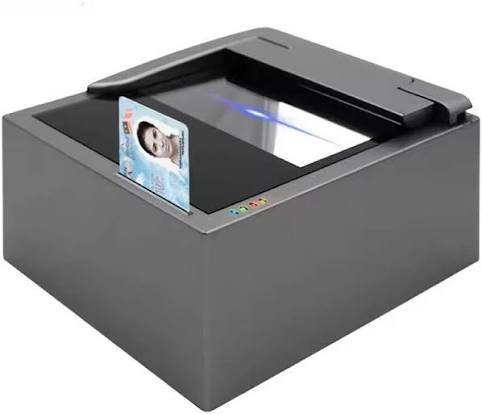
The KR100(C) Kiosk Passport Reader is built for embedded, self-service environments making it a natural fit for hospital self-check-in kiosks and clinic registration terminals. With its compact footprint (169 x 193 x 104.3mm without cover) and removable cover design, it can be integrated into kiosk enclosures without disrupting existing hardware layouts.
Key capabilities relevant to healthcare deployment:
- Reads ID-1 (ID cards), ID-2 (visas), and ID-3 (passports) per ICAO 9303 standards
- Extracts chip data via RFID (ISO/IEC 7816), supporting e-passports and e-ID cards
- Captures images under both visible and IR (850nm) illumination for document authenticity checks
- USB 2.0 interface with a complete OCR SDK (DLLs, OCXs, WebSocket, sample code) for C#, C/C++, Java, Delphi, and VB.NET — allowing VANDA to integrate it directly into existing hospital information systems (HIS) or patient management software
For a hospital rolling out self-service kiosks to reduce front-desk congestion, the KR100(C) allows patients to scan their own ID or passport, with data flowing straight into the registration system no manual entry required.
QR1000(I): Full-Page Reading for Front-Desk and Admissions Counters
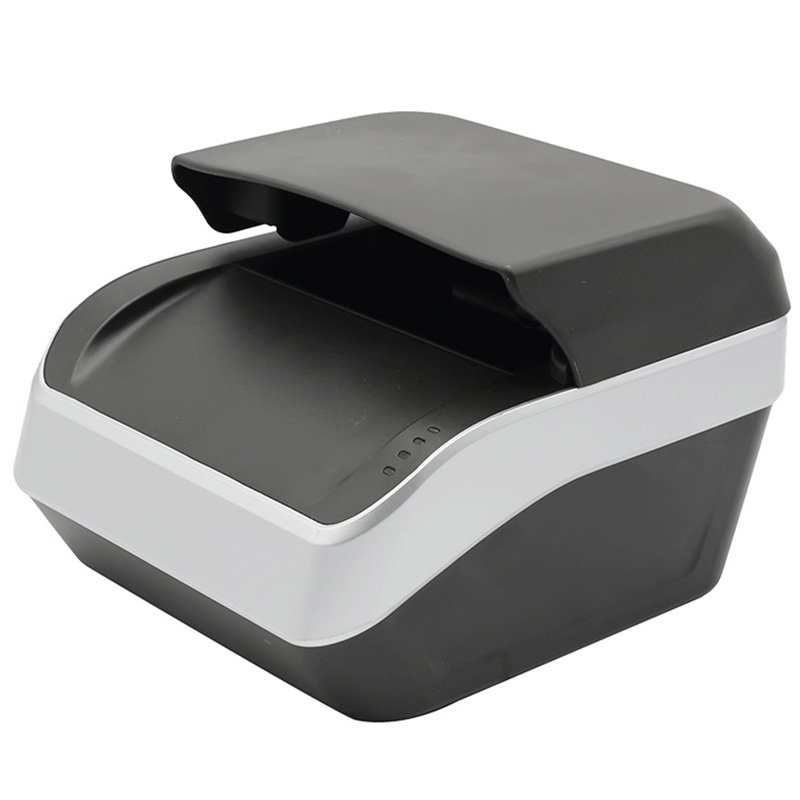
The QR1000(I) Full Page Passport Reader is designed for staffed reception counters, admissions desks, and administrative offices where speed and document security both matter. Its full-page scanning design accommodates passports, visas, ID cards, and driver’s licenses in one motion.
Notable features that support clinical and hospital use cases:
- Support for e-passport Basic Access Control (BAC) and Extended Access Control (EAC), along with active/passive authentication — important for facilities handling international patients or medical tourism
- Built-in security checks: UV dull paper check, MRZ comparison, portrait comparison, and IR B900 ink check — helping front-desk staff catch fraudulent documents before they enter the system
- 5.0 Megapixel CMOS sensor with visible and IR illumination for clear, verifiable document images
- Same broad OS and programming language support (Windows, Linux, Android; C#, C/C++, Java, Delphi, VB.NET) for straightforward integration into existing hospital software
For admissions teams verifying identity for insurance processing, medical records, or cross-border patient care, the QR1000(I) adds a layer of document-fraud detection that manual review often misses.
Why This Matters for VANDA’s Healthcare Clients
Clinics and hospitals are under constant pressure to reduce wait times, protect patient data integrity, and meet compliance requirements, all while managing tight staffing budgets. By pairing VANDA’s implementation and support services with proven, ICAO-compliant hardware like the KR100(C) and QR1000(I), healthcare facilities gain:
- Reduced administrative workload — staff spend less time on manual data entry and more time on patient care
- Fewer identity-related errors in medical and billing records
- Stronger fraud detection at the point of registration
- Scalable deployment options — from self-service kiosks (KR100(C)) to staffed counters (QR1000(I))
- Seamless integration into existing hospital information systems through open SDKs and multi-language support
Conclusion
Patient registration doesn’t have to be the slowest part of a clinic or hospital visit. With VANDA’s integration of the KR100(C) Kiosk Passport Reader and QR1000(I) Full Page Passport Reader, healthcare facilities can automate identity capture, reduce errors, strengthen document security, and give patients a faster, smoother first impression of care. For hospitals and clinics looking to modernize their front-desk operations, this is a practical, proven step toward more efficient, more secure patient management.